







(Keynote Speech at the 7th edition of the International Conference on Biospheric Harmony (ICOBAR 2025), Jakarta, 23 August 2025)
Oleh: STIJN CORNELIS VAN HUIS (Agustus 2025)
Ladies and gentlemen, the rector of Binus University, Ibu Nelly, Vice rector of Research and Technology Transfer, Prof Juneman, distinguished colleagues and students,
Today I will talk about disruption. According to Oxford’s dictionary, disruption has two meanings:
- a situation in which it is difficult for something to continue in the normal way; the act of stopping something from continuing in the normal way
- significant change to an industry or market due to innovation in technology [1]
Technological progress has always brought significant changes. And often these changes are a source of worries and anxiety within society. At the mid of the 19th century at the start of industrialization Charles Dickens already wrote about the impact that industrialization had on urban communities. In his monumental work “Hard Times” Dickens indeed describes how social live was disrupted in industrialized towns. Such societal changes caused by innovation are called societal or social disruption.
The second definition of market disruption has its source in economic analysis. Here, disruption doesn’t mean technology’s impact on society but changes in market dynamics caused by technological innovation.
Perhaps some of you remember the following device.

The case of Kodak shows how technological innovation (=digital photography) disrupted the market position of the leading company in photography. Too late Kodak acknowledged the potential of digital photography and as a result Kodak lost its leading position in the photography market. A clear example of market disruption that was caused by innovation.
Legal Disruption
Let me now return to my own field, the field of law. How are technological disruption and the field of law connected? In recent years, with the rise of artificial intelligence, an increasing number of scholars have signaled that traditional laws are no longer sufficient to regulate AI, and therefore the legal field is disrupted. Thus, the term legal disruption was invented. Legal disruption refers to a situation in which traditional legal norms no longer suffice to regulate the new technology.
Legal disruption can be direct and indirect.
- Direct disruption of legal concepts means that traditional legal concepts are not applicable or must be applied in a different way. For example, who is liable when accidents happen with self-driving cars?
- Indirect disruption is a situation in which societal disruption caused by innovative technologies is taken into consideration by lawyers: in judgments of courts and in new laws and policies designed to mitigate negative impacts of new technologies.
An example of direct legal disruption is the question of who is liable when a self-driving car crashes, the driver when he is not paying attention, the company that developed the cars, or both? In the case of Tesla the judge decided that Tesla was liable– even when the driver acknowledged that he was not fully paying attention when the accident happened [2]. An example of indirect legal disruption is when societal disruption requires legislative action. For instance to counter the stream of fake news made possible by new technologies and social media.
Jeroen Hopster [3] Has underlined that it is important to differentiate between different levels of disruption to analyze whether interventions are necessary. He differentiates between:
- First-order disruption, which mainly concerns narrow market disruption caused by new technologies.
- Second-order disruption, which concerns broad disruption within (segments of) society (social disruption)
- Deep disruption, by which is meant disruptions that challenge or change ethical concepts and have the capacity to fundamentally remake our society and ourselves in terms of our ethical self-understanding (conceptual disruption)
I have built on Jeroen Hopster’s and Guido Löhr’s [4] [5] analytical frameworks on disruption to come with the following analytical framework [6].
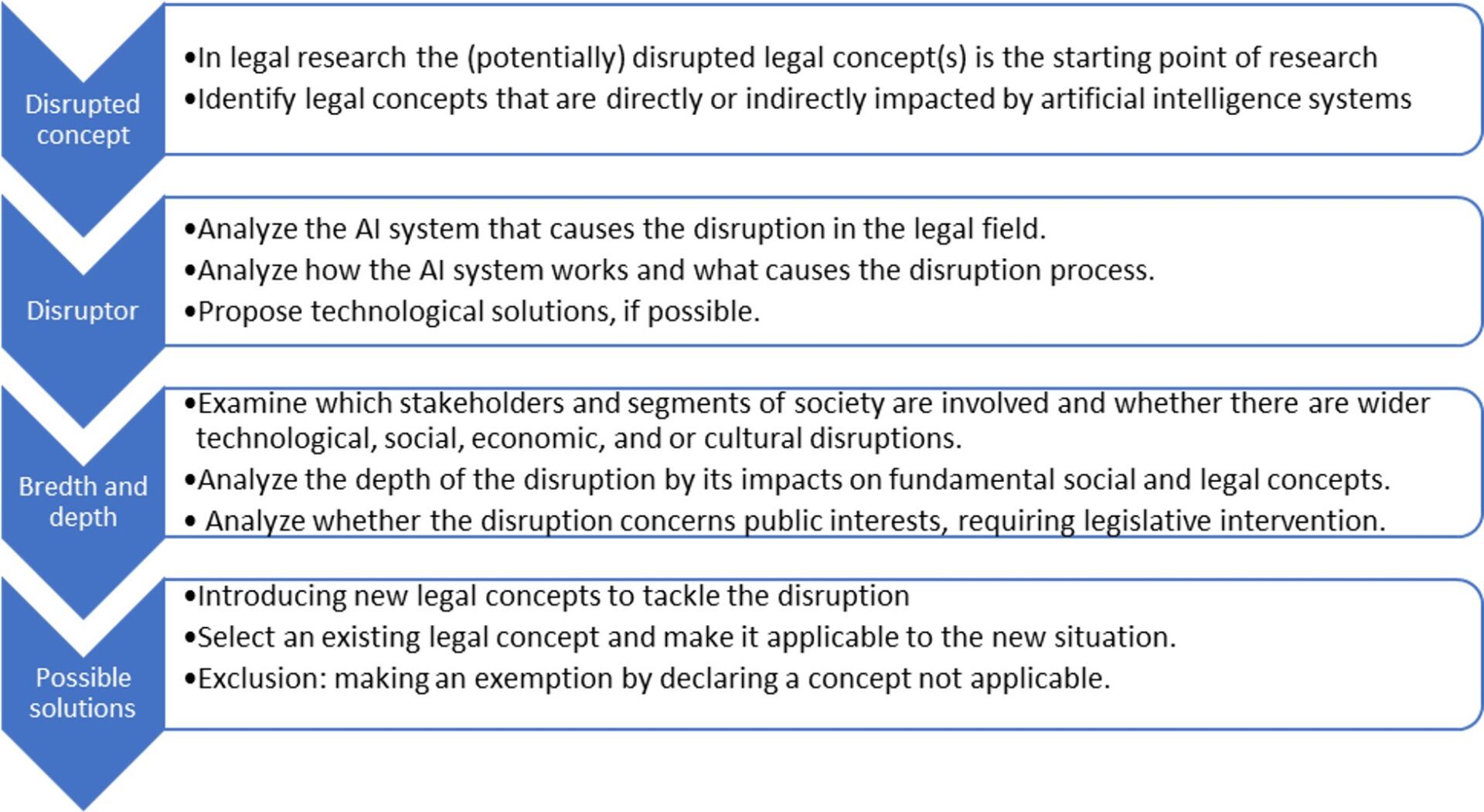
This framework underlines how multidisciplinary empirical research on disruptive effects of new technologies can inform us about the level of disruption and potential solutions. Can the issues be solved with technical solutions, self-regulation, or is legislative intervention necessary?
Let’s take as example the application of automated decision making in the courts (and elsewhere) and look how, through the framework, we can assess whether legislative intervention is necessary. The issue relating to automated decision-making is what is called “the black box problem”: we don’t exactly know how AI comes to a decision. This opaqueness is incompatible with the “duty to provide reasons: the principle that judges must base their decisions on sound legal justification. The lack of justification in automated decisions implies that a fundamental legal principle is disrupted [7].
A potential technical solution to the lack of justification would be that we ask AI to provide a legal justification after the decision has been made. However, while in such a case the legal justification criterium is met, it still remains unclear whether the judgment in reality was based on that exact justification. We simply don’t know – the technical solution does not solve he black box problem itself.
Another issue that might appear is that the use of automated decisions is not accepted within society, as persons feel that their right to be heard and right to due process is not fulfilled unless a human judge listens to their arguments and makes a judgment. Too much automation in the legal sphere may undermine the legitimacy of the legal system. In that case legal disruption leads to broad social disruption and accumulates in deep social and legal disruption as in an atmosphere of general distrust the legal system cannot fulfil its function as independent arbiter.
Because of potential deep social and legal disruptions, the solution is legal intervention: by regulating and limiting the use of automated-decision-making and only allowing automated decision-making in certain simple cases, whereas in complex or sensitive cases, it may only be used as a tool to assist the judge.
With this example I will end my presentation.
Thank you for your attention.
References
[1] https://www.oxfordlearnersdictionaries.com/definition/english/disruption
[2] https://www.theguardian.com/technology/2025/aug/01/tesla-fatal-autopilot-crash-verdict
[3] Hopster, J. (2021). What are socially disruptive technologies? Technology in Society, 67. https://doi.org/10.1016/j.techsoc.2021.101750
[4] Löhr, G. (2023). Conceptual disruption and 21st century technologies: A framework. Technology in Society, 74. https://doi.org/10.1016/j.techsoc.2023.102327
[5] Hopster, J., & Löhr, G. (2023). Conceptual Engineering and Philosophy of Technology: Amelioration or Adaptation? Philosophy & Technology, 36(4). https://doi.org/10.1007/s13347-023-00670-3
[6] Huis, S.C. van, (Forthcoming), “Exploring Possibilities for Multidisciplinary Empirical Legal Research on Disruption by Artificial Intelligence”. Paper presented at the 3rd International Conference on Digital Humanities and Environmental Sustainability (CODHES), Semarang, 30 October- 1 November 2026.
[7] Example taken from Brożek, B., Furman, M., Jakubiec, M., & Kucharzyk, B. (2023). The black box problem revisited. Real and imaginary challenges for automated legal decision making. Artificial Intelligence and Law, 32(2), 427–440. https://doi.org/10.1007/s10506-023-09356-9.