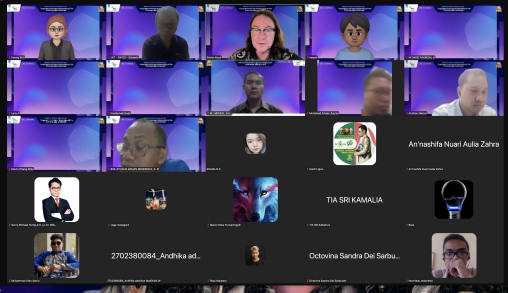






On 24 August 2026, the Master of Business Law Program at Bina Nusantara University held its inaugural webinar, featuring Professor Stefan Koos as the distinguished speaker. Professor Koos, who is based at the Bundeswehr University in Germany, also serves as a visiting professor in BINUS University’s Master of Business Law Program. In the webinar, he delivered a presentation entitled “Copyright in the Age of Generative AI: the Evolving Legal Landscape.”
The central argument of Professor Stefan Koos’s presentation was that the relationship between generative AI and copyright cannot be resolved by asking the seemingly simple question, “May an AI system be trained on copyrighted works?” The legal analysis must instead be conducted stage by stage throughout the AI process. It must also distinguish between two separate issues: whether the use of copyrighted works constitutes infringement and whether AI-generated outputs are themselves eligible for copyright protection.
The presentation began with the classical principle that copyright protects original expression rather than ideas and that protection requires a “personal intellectual creation.” On this basis, Professor Koos divided the relationship between AI and copyright into four principal questions: whether copyrighted works may be used for AI training; whether AI-generated outputs may infringe copyright; whether AI-generated works may receive copyright protection; and, if they are protected, who should be regarded as their author.
There are five most important messages of the presentation.
- “AI training” should not be treated as a single legal act. The different stages must be distinguished: scraping or acquisition → temporary training copies → training → model weights → memorization → output. An exception that legally justifies one stage does not necessarily justify the subsequent stages. This was perhaps the most important legal thesis of the entire presentation.
- The central debate is shifting from “training” to “memorization.” Model weights are essentially statistical parameters rather than collections of files. However, if protected expression can be reconstructed from a model, the question arises whether the AI system has merely “learned” from the work or has, in fact, “stored” or reproduced it. GEMA v. OpenAI provides an important example: nearly verbatim outputs were relied upon as evidence that the works had been memorized within the model.
- There is no universal rule that AI training is always lawful or always constitutes infringement. In the United States, the application of the fair use doctrine depends heavily on the particular conduct involved and the evidence presented. For example, Bartz v. Anthropic distinguished among acquisition, digitization, and training, while Kadrey v. Meta demonstrated the importance of evidence concerning market harm. Consequently, merely stating that “training is transformative” does not resolve the legal issue. In Europe, a text and data mining (TDM) exception exists, but the AI Act merely imposes compliance and transparency obligations; it does not constitute a licence to use copyrighted works.
- Copyright protection for AI-generated works remains fundamentally human-centred. The central question is not simply whether AI was used as a tool, but whether a human exercised sufficient creative control for their creative choices to be identifiable in the final output. A lengthy or complex prompt is not necessarily sufficient. The United States generally emphasises human control; Germany and the European Union focus on an identifiable human creative imprint; and Chinese courts appear relatively more willing to assess human contributions throughout the creative process, including prompts, parameters, iterative refinement, selection, and editing.
- The challenges created by AI ultimately extend beyond copyright law. Style in itself is generally not protected by copyright; copyright protects concrete expressions. Nevertheless, AI can generate thousands of imitations at an exceptionally low cost. The legal concern therefore expands to include scalability, market substitution, attribution, reputation, and cultural impact. Professor Koos consequently raised the question of whether these issues should instead be addressed through unfair competition law, personality rights, the doctrine of false endorsement, platform regulation, or the creation of new rights outside the traditional framework of copyright law.
At the end of the webinar moderatorated by Shielda Natasha — one of the students of the BINUS Master of Law Program, Prof. Koos concluded that copyright law cannot assess AI as a single “black box”. It must determine who performed which act, at what stage of the AI pipeline, whether a work was merely learned from or could be reconstructed, what the model produced, and the extent to which a human exercised creative control over the final output. The concluding section also conveyed an important philosophical message: AI has not displaced the human being from the centre of the concept of authorship. Even where AI-generated outputs possess economic value, the law may choose to confer rights upon humans through statutory attribution without recognising AI as an “author” or a legal person. He expressly posed the question: “Is AI personification necessary—or is the attribution of rights sufficient?”
The presentation also addressed a particularly important issue for Indonesia. This country has not yet adopted a specific TDM provision comparable to that of the European Union. Consequently, many questions that have begun to receive more specific legal treatment in the United States, the European Union, Japan, Germany, and China still require clearer legal construction within the framework of Indonesian copyright law. (***)