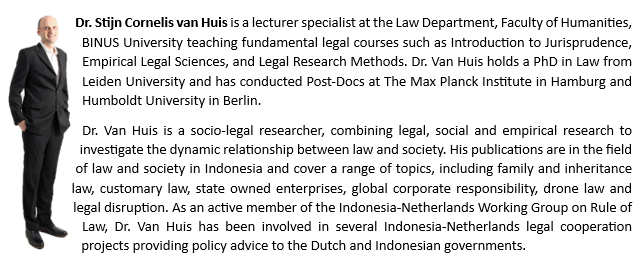








Oleh STIJN CORNELIS VAN HUIS (Februari 2026)
A representative democracy in the narrow sense can be defined as rule by the people, through free elections, held on regular basis, in which people choose their representatives. Yet, in the democratic world there is consensus that the formal aspect of ‘rule by the people’ also should supplemented with ‘a rule of values’ including the separation of powers, the rule of law, judicial independence, human rights and basic principles such as morality and justice, social objectives (public good, security, legal certainty) and appropriate ways of behaviour (reasonableness, good faith) [1]. In a constitutional democracy, these formal and substantive aspects of democracy are laid down in the constitution.
The first substantive aspect of democracy mentioned above is the separation of powers as modelled to Montesquieu’s ‘trias politica’. In this system, the executive, legislative and the judiciary have separate roles laid down in law, to ensure a system of checks and balances. The legislative is responsible for lawmaking and checks the executive. Both the legislative and the executive are bound by their mandate as provided by law. The competence (and interdependence or balances) of the three powers is established in law – most commonly the constitution.
One of the most important aspects of the concept of separation of powers is that when the legislative or the executive transgresses the boundaries of their mandate the court can act and nullify their decisions. Thus, in a democracy one of the essential features is a ‘rule of law’ in which the government and legislative themselves are bound by the law [2]. This places the judiciary as the main guardian of ‘checks and balances’ within the system of separation of powers. The court can only execute this important guardian function properly, if judges in their decision-making are as much as possible free from outside pressures, including from the legislative and the executive. Judicial independence therefore is enshrined in the constitution as well.
The judiciary as guardian of the constitution
Over the years, the powers of the judiciary within most democracies have increased, now also including the role as guardian of the constitution. Following the United States’ model many democracies have enabled judicial review by the judiciary (Supreme court, or Constitutional court) of laws passed by the legislative. In this review process, the passed laws are reviewed on their ‘constitutionality’ and certain rules weighted in view of the norms, principles and values laid down in the constitution. In this system, laws enacted by parliament, or more accurate, certain rules laid down in legislation, if found ‘unconstitutional’, can be annulled by court.
The increased powers of the judiciary within the constitutional democratic system have been criticized by some academics for being undemocratic. The role of the judiciary within the system of checks and balances, they argue, would have become too strong, disturbing the delicate balance between the legislative, executive and the judiciary [3]. Laws should be by the people and for the people, which in a representative democracy means that it should be the exclusive terrain of the people’s representatives – the legislative.
Although this argument seems plausible, Dworkin rejects it. As mentioned above, the concept of representative democracy comprises of more than just rule by the people’s representatives. Democratic values must be ensured and ‘dictatorship of the majority’ rejected when decisions of the legislative infringe on the substantive democratic values that form the prerequisites for democracy – including the (human) rights of minorities and disadvantaged groups. As Dworkin) argues: ‘If we understand democracy to mean not majority rule in itself, but majority rule under appropriate conditions, then [the constitutional review powers of the judiciary] does not compromise but rather protects democracy when effective means are deployed to secure those conditions’. Dworkin prefers to trust this guardian role to the judiciary, rather than the legislative which he by nature considers unsuitable for this job, since according to him ‘democratic politicians now rule by representation […] which means by compromises, trade-offs and political deals that do not even aim at coherence’ [4].
Undemocratic aspects of constitutionalism
The question remains how in a representative democracy such a strong role of an undemocratically elected body such as judiciary can be legitimized. In a representative democracy the elected representatives should be ‘supreme’ and make the laws. However, within a constitutional democracy the constitution is commonly considered to be supreme with the judiciary as its guardian. ‘When a constitution is adopted, the legislator is obliged to uphold its provisions. The task of the court is to protect the constitutional provisions and ensure that the legislative fulfils its obligation [to uphold its provisions]’ [5]. How can such weight on the constitution be legitimized? Here the argument gets caught up in a vicious circle. Since the democratic substantive norms and values that form the prerequisites for a democracy are enshrined in the constitution, the constitution becomes the guardian institution against any majority of elected representatives that intends to change these democratic norms and values. To protect democracy, democratic norms and values are treated as fundamental values that are absolute and underogable, to be protected by the courts, thus affecting the democratic mandate of the legislative. Inevitable a constitutional democracy is “self-referential and inherently paradoxical” [6], as constitutional norms provide courts superior weapons against legislative majorities.
Exploitation of constitutionalism’s undemocratic aspects
These undemocratic aspects of constitutionalism (placing the constitution above majority decisions) are subject to criticism as they may prevent legislative interventions and therefore are undemocratic [7]. For instance, in the USA redistributive policies may be annulled on grounds of incompatibility with liberal economic norms enshrined in the constitution, even if there would be a democratic majority for such policies [8].
One of the solutions offered for the democracy issue of constitutionalism is by strengthening the so-called “fourth pillar” in the checks and balances – consisting of civil society, independent watch dogs, and a free press, that monitor the functioning of the main three pillars of ‘trias politica’. Yet, as we can see during the rise of populist the USA, the constitutionalist nature of the fourth pillar has now become the target of the populists. The lens of fundamental rights and rule of law is said to be leftish, elitist, out of touch with the opinions of the people, and therefore undemocratic These accusations by populists effectively stem, or at least divert, any criticism concerning the undemocratic or unconstitutional character of some of their (proposed) policies. Court decisions are treated in a similar fashion. Thus, justified in terms of ‘voicing the will of the people’, the undemocratic aspects of constitutionalism are exploited by populists in their attempts to reduce the scope of fundamental rights and sabotage effective checks and balances that are enshrined in the constitution. In this battle between the four pillars of checks and balances in the USA, the judiciary has proven to be the most effective guardian of the constitution in the short term, proving Dworkin right. The long-term effects of this battle on the system of check and balances may be more serious. Only time will tell how strong the shield of the constitution is […].
References
[1] Barak, A. (2006), The Judge in a Democracy, Princeton: Princeton University Press, pp 24.
[2] Bedner, A. W. (2010). An Elementary Approach to the Rule of Law. Hague Journal On The Rule Of Law, 2(1), 48-74. https://hdl.handle.net/1887/18070
[3] Waldron, J., 2006. The core of the case against judicial review. The Yale Law Journal, 115 (6), 1346–1406. doi:10.2307/20455656
[4] Dworkin, R. (2003). Judge’s New Role: Should Personal Convictions Count? Journal of International Criminal Justice, 1(1), 4–12. https://doi.org/10.1093/jicj/1.1.4
[5] Barak, A. (2006), The Judge in a Democracy, Princeton: Princeton University Press, pp 94-95.
[6] Olson, K. (2007). Paradoxes of Constitutional Democracy. American Journal of Political Science, 51(2), 330–343.
[7] Waldron, J., 2006. The core of the case against judicial review. The Yale Law Journal, 115 (6), 1346–1406. doi:10.2307/20455656
[8] Waldron, Jeremy. “Constitutionalism: A Skeptical View.” Philip A. Hart Memorial Lecture, Georgetown Law, 2010. Georgetown University